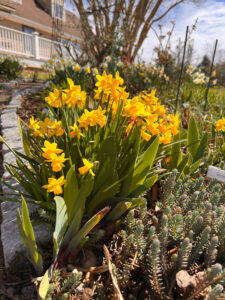
Don’t know about you, but seasonal depression knocked me for a loop this year. Between the state of the world and the awful winter here in Virginia, I struggled to get out of bed each morning. But here we are, almost spring, and the flowers are starting to do their thing. I live for this season. Walking in the garden, it’s like someone has left me fairy gifts amongst the leaves (still waiting to be cleaned up), with the various flowers stretching their necks to greet the sun. Finally!
The Lenten Rose is the first in my garden, followed by the crocus, and then the daffodils. The daffs, to me, are the true harbringer of spring, as I have planted so many, in so many different spots, that the property just bursts with yellow, white and orange color.
Daffodils have several names: Narcissus is the scientific (genus) name for all daffodils. Daffodils, though used commonly for the entire genus, technically refers to those with the large trumpet-shaped flowers. And Jonquils applies to the species Narcissus jonquilla, typically having several fragrant flowers per stem with dark green foliage.
They are toxic as a neighbor: put daffodils in a vase with other flowers (in particular, tulips) and their sap (which is toxic to other plants) can cause the other plants to wilt prematurely. If you place the daffodils in a separate vase of water for 24 hours, allowing the sap to bleed out, you’ll have more luck mixing them in bouquets.
They are virtually pest-proof as they contain calcium oxalate crystals which make the bulbs and leaves toxic to deer, rabbits and squirrels.
There are over 32,000 cultivars of daffodils!